Why your front steps moved this winter, and what actually fixes it
If one end of your front steps is lower than it was in October, the stone is not the thing that failed.
September 9, 2026 · 4 min read
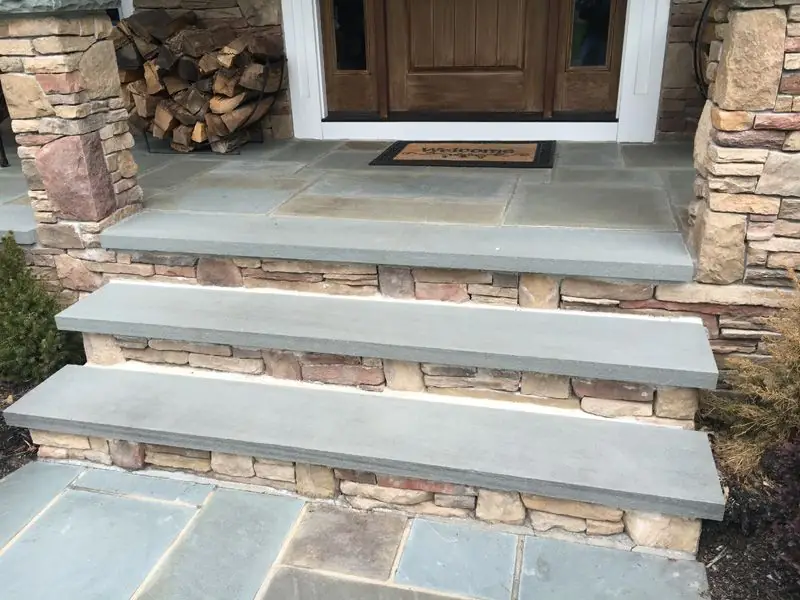
Every year, once the ground has thawed, we get calls about front steps. The complaint is nearly always the same: one end has dropped, or the treads no longer sit level, or there is a gap opening between the steps and the house that was not there in the autumn. People usually assume the stone or the brick has failed. It almost never has.
Water, freezing, and the only mechanism that matters
Northern New Jersey moves through the freeze and thaw cycle repeatedly between December and March. Water sitting in the ground under a set of steps expands as it freezes. That expansion has to go somewhere, and the easiest direction is up. When it thaws, the ground settles back, but not always evenly and not always to where it started. Repeat that a dozen times over a winter and anything sitting on shallow ground gets lifted, tilted, and set back down slightly out of true.
This is why the failure is seasonal and why it tends to appear all at once in spring rather than gradually. It is also why it usually affects one end more than the other. The end that holds more water, or sits on softer ground, or catches the runoff from a downpipe, moves further.
The two things that decide whether steps move
The first is the depth of the footing. A footing that sits above the frost line is inside the zone of ground that freezes and expands every winter. It will be lifted, because the ground it rests on is doing the lifting. A footing carried below that depth is sitting in ground that stays at a stable temperature, so there is nothing to lift it.
The second is the base. Material that has been dumped in and levelled in one pass has voids in it, however flat the surface looks. Those voids fill with water, and water is the whole mechanism. Base built up and compacted in shallow lifts has far less room for water to collect, and it does not consolidate under load later on the way loose fill does.
Both of those decisions are made before a single piece of stone is laid, and neither is visible in the finished job. That is exactly why they get skipped on price, and why two sets of steps that look identical on the day can behave completely differently three winters later.
What drainage has to do with it
The third factor is where the water is coming from in the first place. A downpipe discharging next to the steps, a walkway that falls back toward the house, or a garden bed that has crept up above the level of the stone will all keep the ground beside the steps saturated. Saturated ground freezes harder and lifts further.
This is worth checking yourself before you call anyone. Go out during heavy rain and watch where the water actually goes. If it is arriving at the steps or standing beside them, that is a large part of the problem and it can often be improved separately from any masonry work.
Why relaying the top does not work
The tempting repair is to lift the treads that have moved, pack underneath them, and reset them level. It looks finished and it costs a fraction of the alternative. It also lasts until the next winter, because nothing about the footing depth, the base or the drainage has changed. The ground will do exactly what it did before.
There are cases where a surface repair is genuinely the right answer, usually where the movement was a one off caused by something specific that has since been fixed. But if the steps have moved in more than one winter, the problem is underneath and a surface repair is money spent twice.
What to look at before you call anyone
- Are the risers still equal in height, or has one become noticeably taller or shorter than the others
- Is there a gap opening between the steps and the house wall, and is it wider at one end
- Does water stand beside the steps after rain, and where is it coming from
- Is the cap or the top tread still level across its width, or does a marble roll off it
- Have the mortar joints cracked in a straight line, or crumbled generally across the whole face
Straight line cracking usually means movement. General crumbling that you can pick out with a finger is more often age in the mortar itself, and that is a repointing job rather than a rebuild. The difference matters, because one is a repair and the other is not.
The honest answer
Sometimes steps need rebuilding, with the footing taken to a proper depth and the base rebuilt underneath. Sometimes they need repointing and a drainage fix and nothing more. The only way to tell is to look at them, in person, and to look at where the water goes rather than only at the stone.
If your steps moved this year, it is worth having someone look before another freeze cycle, because the damage compounds. Call our office on (201) 945-0064 with the address and we will come out and tell you which of the two it is.
Adamo Brothers Construction Inc., (201) 945-0064
Call (201) 945-0064More articles
How to tell a drainage problem from a masonry problem
Most masonry we are asked to repair did not fail because of the masonry.
What good site preparation looks like before anything is built
Nobody photographs the site preparation, and it decides how the rest of the project behaves.