05
Excavation and demolition
Site preparation, land clearing, soil removal, backhoe services, trenching, drainage systems, grading and levelling, plus tear-downs and fire or flood damage demolition.
Chapter 01
The risk on a demolition job is what you cannot see
Taking a structure down is the straightforward half. The part that decides whether a demolition goes well is the survey work before it: what services run into and under the building, what is shared with a neighbouring structure, what the ground is doing, and what has to be protected and left standing. On the tight lots common across Bergen and Hudson Counties, party walls and boundaries are usually the constraint that shapes the whole method.
Fire and flood damage work adds another layer, because the structure has already been altered by the event. What is sound and what merely looks sound are not the same thing, and material that has been through a fire or sat wet behaves differently. That work has to be approached as an assessment first and a demolition second.
Excavation carries its own version of the same principle. The expensive incidents on excavation jobs are almost always a service nobody knew was there, or ground that behaved differently once it was opened up. Neither is solved by a bigger machine.
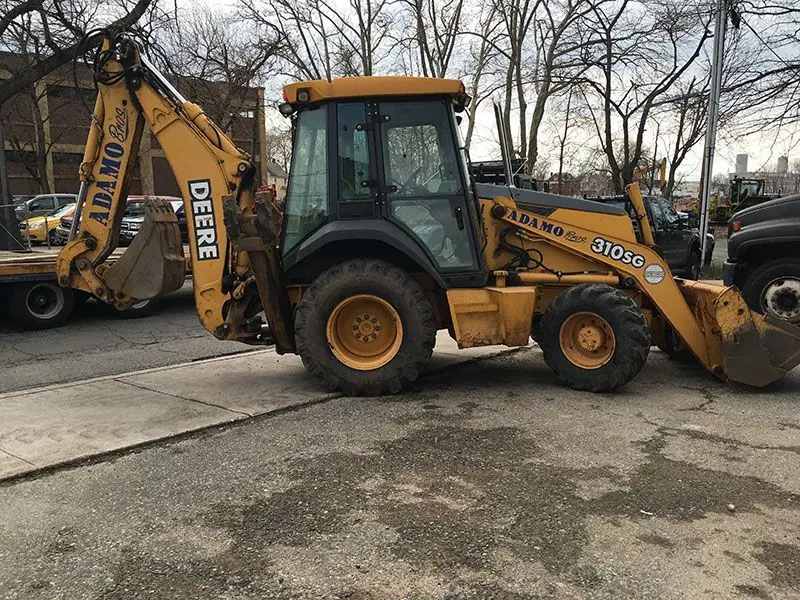
Adamo Bros branded John Deere 310SG backhoe loader parked roadside in Ridgefield, New Jersey
How we sequence it
We establish what is on and under the site before anything is opened up, and plan the sequence so that access, protection and disposal are all worked out in advance rather than improvised. Soil removal and trenching are planned alongside the drainage design, so a trench is dug once and to the right depth rather than reopened later by another trade.
For tear-downs the method follows the structure and the neighbours rather than a standard routine. Material is separated as it comes down where that is worthwhile, and the site is left graded and safe rather than simply cleared, because in most cases something is going to be built there and the next stage begins with the levels we leave behind.
We own and operate our own machines out of the Ridgefield yard, including the backhoe you can see on this page, and our operators have been with the company for over twenty years. On demolition and excavation that ownership matters for scheduling: we are not waiting on a hire company or a subcontracted operator to become available.
Chapter 03
What happens after the machines leave
A properly finished excavation or demolition leaves a site you can build on, not just an empty one. That means the levels are set, the ground is stable, drainage runs where it should, and anything retained is properly supported. If the next stage is ours as well, the formation we leave is the formation we then build to.
Where the site is going to sit for a while before work starts, the important thing is that it drains and does not erode. Ground left open with nowhere for water to go will soften and wash, and the cost of that reappears when the foundations go in.
If you have a structure to remove, ground to open up, or a drainage problem you have not been able to trace, call the office on (201) 945-0064. We will come out, look at it properly, and tell you what the job actually involves.
Adamo Brothers. Fully licensed, bonded and insured. NJ Home Improvement Contractor Lic. #13VH00015800. Call (201) 945-0064.