01
Masonry
Steps, stucco, patios, outdoor kitchen countertops, chimneys, retaining walls, piers and seawalls, interlocking paving stones, Versa-Lok and Keystone walls, plus flagstone, tile and marble accent work.
Chapter 01
Where masonry fails first in northern New Jersey
Almost every failed wall and set of steps we are called out to in Bergen County failed for the same reason, and it is never the stone. Water gets in behind the face or under the base, freezes, expands, and lifts. Northern New Jersey runs through that cycle repeatedly between December and March, so a job that looked perfect in October can be out of level by April.
The visible symptoms are easy to read once you know them. Steps that have dropped at one end, a retaining wall bellied out in the middle, a chimney with joints you can pick mortar out of by hand, a patio with one flag rocking underfoot. Each of those is a drainage or a base problem showing up in the finish. Repointing the face on its own just hides it until the next winter.
The other common one is a retaining wall built as though it were a garden edge. Anything holding back real soil is holding back the water in that soil too, and without somewhere for the water to go it will push a dry laid face over eventually, however good the stonework looks from the street.
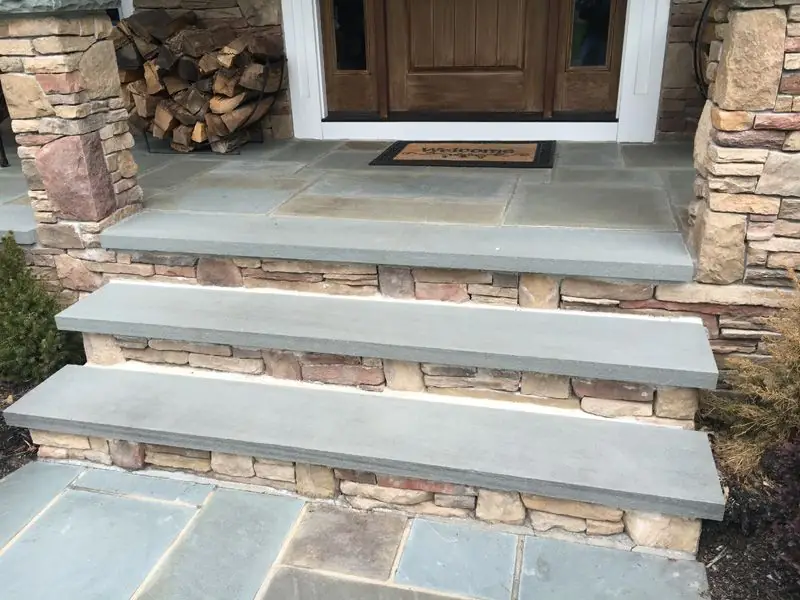
Bluestone entry steps with stacked stone risers and a fitted cap, built by Adamo Brothers Construction
How we build it so it stays put
Footings go below the frost line, not on top of it, and the base under flatwork is compacted in lifts rather than dumped and levelled in one pass. That is the unglamorous half of the job and the only reason the face stays flat. It is also the half a homeowner never sees, which is precisely why it is worth asking any contractor about before work starts.
Behind a retaining wall we run drainage stone against the back of the units with filter fabric between the stone and the soil, so fines cannot migrate in and blind the drainage over time. Versa-Lok and Keystone units are set and pinned course by course to the manufacturer's pattern, with weep holes kept clear. On a dry laid stone face we work to a string line and strike the joints before the mortar sets up hard, because a joint tooled late never seals as well.
Steps and caps are cut to overhang evenly on every exposed side. A cap that overhangs by different amounts front and side is the fastest way to make good stonework look like a repair, and it also decides where the water lands when it runs off. All of this is self performed by our own crews out of the yard at 1033 Alexander Avenue, not subcontracted out.
Chapter 03
What to expect afterwards, and when to call us back
A new wall or patio will often show efflorescence in the first season: a white powdery bloom on the face as salts work out of the masonry. It is normal, it is not a defect, and it generally weathers off on its own. Do not attack it with acid, which will etch the stone permanently.
The things genuinely worth watching are joints and drainage. If mortar joints start to crumble to finger pressure, if a weep hole at the base of a wall stops running after heavy rain, or if a flag begins to rock, those are worth a call before another freeze cycle. Caught early, all three are small repairs. Left through a couple of winters, they become a rebuild.
Chimneys are the one to watch most closely, because they sit exposed on every side and their flashing is doing as much work as their mortar. If you see staining on the ceiling near the chimney breast, the flashing is usually the culprit rather than the brickwork. Call the office on (201) 945-0064 and we will come and look at it before you commit to anything.
Adamo Brothers. Fully licensed, bonded and insured. NJ Home Improvement Contractor Lic. #13VH00015800. Call (201) 945-0064.