03
Concrete work
Poured and pre-cast concrete, concrete vaults, overlays, patios, foundations, sidewalks, curbs and drainage systems, formed and finished by our own crews.
Chapter 01
Concrete does not fail quietly
Concrete tells you what went wrong, if you can read it. A long straight crack running between two re-entrant corners usually means the control joints were cut too late, too shallow, or not at all, so the slab chose its own place to crack. A network of fine surface crazing usually means the finish was worked while there was still bleed water on top. Spalling, where the top few millimetres flake away, is very often a freeze-thaw problem made worse by de-icing salt.
Settlement is a different story again. A slab that has dropped at one corner has usually lost the ground beneath it, either because the fill was never compacted properly or because water has been running under it and carrying fines away. Grinding the trip hazard off the top does nothing about that, and it will keep dropping.
In northern New Jersey the freeze-thaw cycle is the constant background pressure. Anything poured thin, poured on unprepared ground, or finished badly will be found out by the second or third winter, not the first.
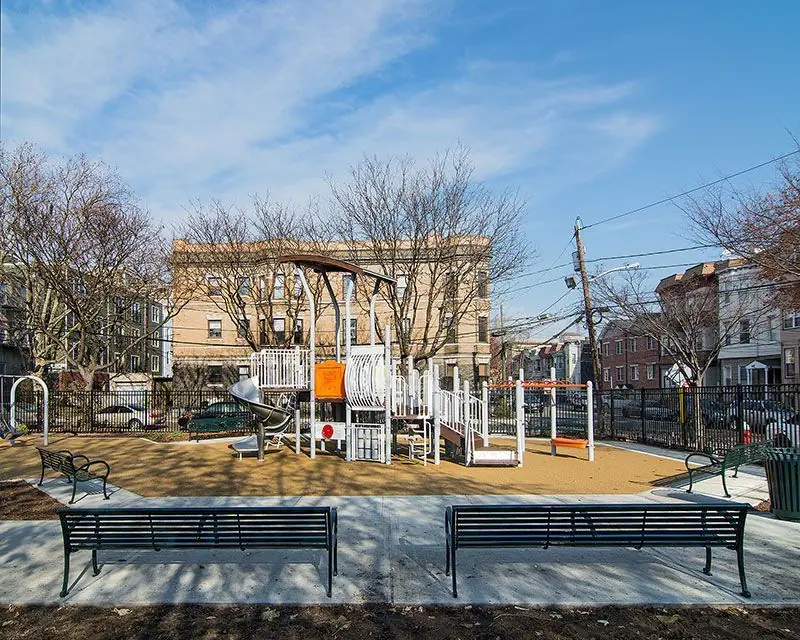
Poured concrete walkway and bench pads with curb edging at a municipal playground built by Adamo Brothers
Forming, pouring and finishing
We prepare and compact the sub-base before forming, and set the forms to the fall we want rather than to whatever the existing ground happens to do. Reinforcement is placed and supported so it sits in the body of the slab where it can do something, not lying on the sub-base where it is decorative. Thickness is matched to the use: a garden path, a driveway carrying a vehicle and a commercial pad carrying deliveries are three different pours.
Control joints are cut to a real proportion of the slab depth and at spacings that suit the geometry, early enough to control where cracking happens. This is one of the least visible decisions on any concrete job and one of the most consequential, because a slab will crack somewhere and the only question is whether you chose the line or it did.
Beyond flatwork we pour foundations, form concrete vaults, set pre-cast units and build drainage systems, and we run concrete overlays where an existing slab is sound underneath but tired on top. Because our own excavation and site work crews prepare the ground, the pour is not waiting on somebody else's programme.
Chapter 03
The first winter, and the years after
New concrete keeps gaining strength for weeks after it looks finished. Keep heavy vehicles off fresh flatwork for the period we tell you on the job, and be careful with de-icing salt through the first winter in particular, since it drives the freeze-thaw damage that causes surface spalling. Sand gives grip without the chemistry.
After that, the maintenance is mostly about water again. Keep joints sealed, keep downpipes and drainage discharging away from slabs rather than alongside them, and watch for any corner starting to drop, which is a sign of ground movement rather than a concrete problem.
Hairline surface cracks are common and usually cosmetic. Cracks with a lip you can feel, cracks that keep opening season on season, or a slab that has visibly settled are worth a look. Call (201) 945-0064 with the address and we will tell you honestly whether it needs replacing, an overlay, or leaving alone.
Adamo Brothers. Fully licensed, bonded and insured. NJ Home Improvement Contractor Lic. #13VH00015800. Call (201) 945-0064.